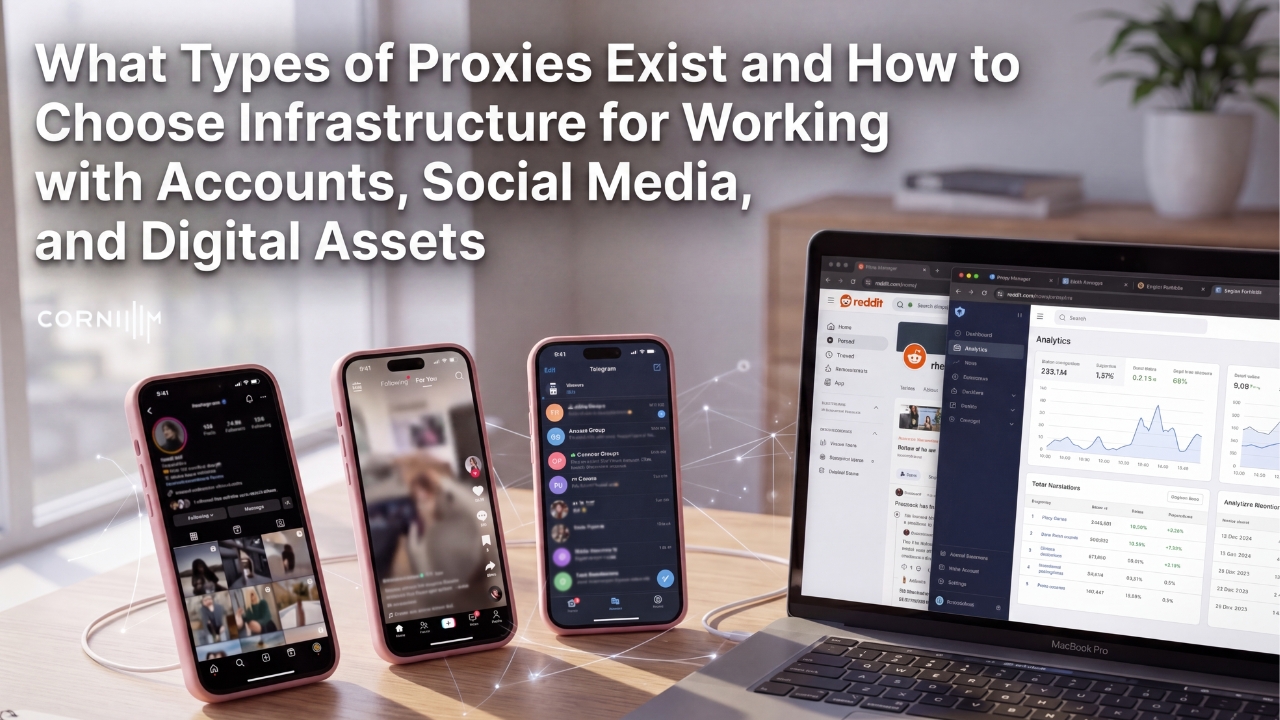
Types of Proxies and How to Choose Infrastructure for Working with Accounts, Social Networks, and Digital Assets

Table of Contents:
- Why Proxies Today Are No Longer Just About "Changing IP"
- What Types of Proxies Exist
- Why Mobile Proxies are Being Used More Frequently Now
- What is the Main Difference Between Datacenter and Mobile Proxies
- Proxy Type and What Teams Usually Get
- How Coronium.io Uses Mobile Infrastructure
- Why the Digital Asset Market is Increasingly Dependent on Infrastructure
- Conclusion
When a person first starts working with multiple accounts, different platforms, or geos, proxies are usually perceived as something secondary. It seems that the main thing is to find a good asset, assemble a proper bundle, set up advertising, or build analytics, while everything else is just details.
But over time, almost all teams come to the same conclusion: the quality of the infrastructure affects work stability no less than the accounts or platforms themselves.
This is especially noticeable when working with digital assets. Telegram channels, TikTok accounts, Instagram, YouTube, websites, communities — all of these have long since turned into full-fledged business assets around which media, advertising, sales, and entire teams are built. On platforms like Madbid, such assets can be bought, sold, and scaled, but after the deal itself, daily work begins: connecting employees, checking geos, analytics, launching ads, testing, and working with several platforms simultaneously.
And this is where proxies stop being "just an IP."
In practice, they become part of the environment through which the team works every day.
Why Proxies Today Are No Longer Just About "Changing IP"
A few years ago, proxies were more often used for simple technical tasks. Now everything has changed. Platforms have begun to analyze the connection environment much more carefully: IP type, network history, session stability, geo, traffic behavior, and even how natural the connection looks.
Therefore, teams are increasingly looking at infrastructure not as a "way to bypass restrictions," but as a way to make work more stable and predictable.
For example, it is important for a marketer to see advertising through the eyes of a user from the desired region. For a team working with multiple accounts, it is important to separate work environments. Analysts need a proper check of search results and service displays in different countries. And for those working with digital assets, it's important to simply manage all processes calmly without constant technical hiccups.
The problem is that different types of proxies behave completely differently, even though from the outside it seems like there is almost no difference.
What Types of Proxies Exist
Three types of proxies are most commonly used in work:
-
datacenter (server)
-
residential
-
mobile
And here many make their first mistake — choosing proxies only by price or speed, although in real work it is much more important to understand exactly what they are needed for.
Datacenter Proxies are the cheapest and fastest option. They work through data centers, so they usually provide good speed and are inexpensive. This may indeed be enough for simple technical tasks. For example, if you need to check a large number of pages, perform basic collection of public data, or automate simple processes.
But there is a nuance: platforms clearly understand that the IP belongs to a data center, not a regular user. That is why datacenter proxies are not always suitable for long-term work with social networks, ad accounts, or user accounts. The environment looks less natural, meaning the system begins to treat the connection more carefully.
Residential Proxies work through home internet service providers. Such an IP looks closer to a regular home user, so residential proxies are often used for analytics, checking search results, price monitoring, or working with regional services.
For example, if a team needs to check how a website looks in Germany, France, or the USA through the eyes of a regular user, residential proxies are usually much better suited than datacenter ones.
But they also have their own peculiarities. Speed can be less stable, some IPs are used by several users simultaneously, and quality depends heavily on the specific provider.
That is why many teams have gradually begun to switch to mobile infrastructure for working with social networks and accounts.
Why Mobile Proxies are Being Used More Frequently Now
Over the past few years, mobile proxies have become one of the most popular solutions for working with social networks, advertising, and digital assets. And this is not about "fashion," but about how platforms perceive mobile traffic.
If an IP belongs to a mobile operator, the connection looks as natural as possible. And if the proxies also work through real devices with SIM cards, the environment becomes more stable and predictable.
This is especially important in tasks where teams work:
-
with multiple accounts
-
with advertising in different geos
-
with regional analytics
-
with social networks
-
with long work sessions
For example, if a person just opens a website once a week, the difference may be almost unnoticeable. But when a team works daily with several platforms simultaneously, any minor problems start to accumulate very quickly: unstable sessions, constant re-checks, chaotic connections, extra confirmations, and manual routine.
That is why in recent years many teams have started to bet not on maximum speed, but on environment stability.
What is the Main Difference Between Datacenter and Mobile Proxies
The main difference is usually felt not in the first five minutes of work, but later — when processes start to scale.
With datacenter proxies, everything often looks good at the start: fast, cheap, convenient. But as the number of accounts, employees, and platforms grows, small problems start to appear. In some places, the display of services changes, in others, additional checks appear, and in some, you have to constantly reconnect or manually re-verify processes.
Mobile infrastructure is usually built differently. It is initially designed so that the connection looks closer to a regular mobile user.
Proxy Type and What Teams Usually Get
Datacenter - High speed and low price
Residential - More natural home connection
Mobile - Stable environment for long-term work with accounts and social networks
That is why mobile proxies are now often used by teams working with:
-
TikTok
-
Telegram
-
Instagram
-
Facebook
-
Ad accounts
-
Digital assets
-
Multiple geos simultaneously
How Coronium.io Uses Mobile Infrastructure
Coronium.io is built precisely around the idea of a stable mobile environment, rather than just "selling IPs."
The platform uses real 4G/5G/LTE mobile IPs through physical devices with operator SIM cards. This is important because the connection does not work through a general datacenter pool, but through a separate mobile infrastructure.
The Coronium.io website specifically emphasizes:
-
dedicated devices
-
real mobile IPs
-
IP rotation
-
management via panel
-
support for HTTP(S), SOCKS5, and OpenVPN
-
unlimited traffic
-
working with multiple geos
For teams, this no longer looks like "buying a proxy," but like a full-fledged work infrastructure.
It is also useful that the service has built-in verification tools:
-
IP test
-
DNS leak check
-
connection diagnostics
-
proxy quality check
This helps to quickly understand exactly how the connection looks from the platforms' side and whether there are any technical problems within the environment.
Why the Digital Asset Market is Increasingly Dependent on Infrastructure
The digital asset market has grown significantly over recent years. Today, accounts, communities, websites, and channels are no longer "extra pages," but full-fledged business assets.
But the more professional the market becomes, the more important the infrastructure around it becomes.
Because the purchase of the asset itself is only the beginning. Next comes daily work: analytics, management, development, advertising, testing, connecting the team, and working with several platforms and geos simultaneously.
And this is exactly where infrastructure begins to directly affect the stability of processes.
Therefore, the combination of services like Madbid and Coronium.io looks quite logical. One helps work with the digital asset market, the other — to create a more stable environment around further work with them.
FAQ
Which proxies are better suited for social networks?
Mobile proxies are most often used for social networks because mobile IPs look more natural to platforms and are better suited for long work sessions.
Are datacenter proxies suitable for traffic arbitrage?
For some technical tasks — yes. But if a team works with multiple accounts and advertising, mobile proxies usually provide a more stable environment.
When is it better to use residential proxies?
They are well-suited for SEO, checking regional search results, analytics, and monitoring websites in different countries.
Why are mobile proxies more expensive?
Because such infrastructure works through real devices and mobile operators, rather than through regular data centers.
Conclusion
Today, proxies are no longer a narrow technical tool, but part of a normal infrastructure for working with accounts, social networks, and digital assets.
Different types of proxies are suitable for different tasks, so there is no universal option. But the more important environment stability and connection naturalness are, the more often teams switch specifically to mobile infrastructure.
That is why services like Madbid and Coronium.io are increasingly used together: one helps to work with digital assets, the other — to build a more stable work environment around them.
For new users, Coronium.io offers the promo code START15 with a 15% discount on the first order.
Leave a Comment
Comments
No comments yet. Be the first to comment!
You may also like
What to do if Viber, Telegram, Facebook, or Instagram is hacked
06-10-2025
Rating: 0 | Views: 4152 | Reading time: 3 min
Read →
YouTube becomes the world’s largest media company
13-03-2026
Rating: 0 | Views: 1871 | Reading time: 5 min
Read →
How Social Networks Pay Creators for Views in 2026: An Overview of Earnings on YouTube, TikTok, and Instagram
02-09-2026
Rating: 0 | Views: 311 | Reading time: 6 min
Read →
YouTube will improve video quality on TVs using AI
23-02-2026
Rating: 0 | Views: 1610 | Reading time: 3 min
Read →
Search Will Never Be the Same: The Google AI Era
22-05-2026
Rating: 0 | Views: 583 | Reading time: 5 min
Read →