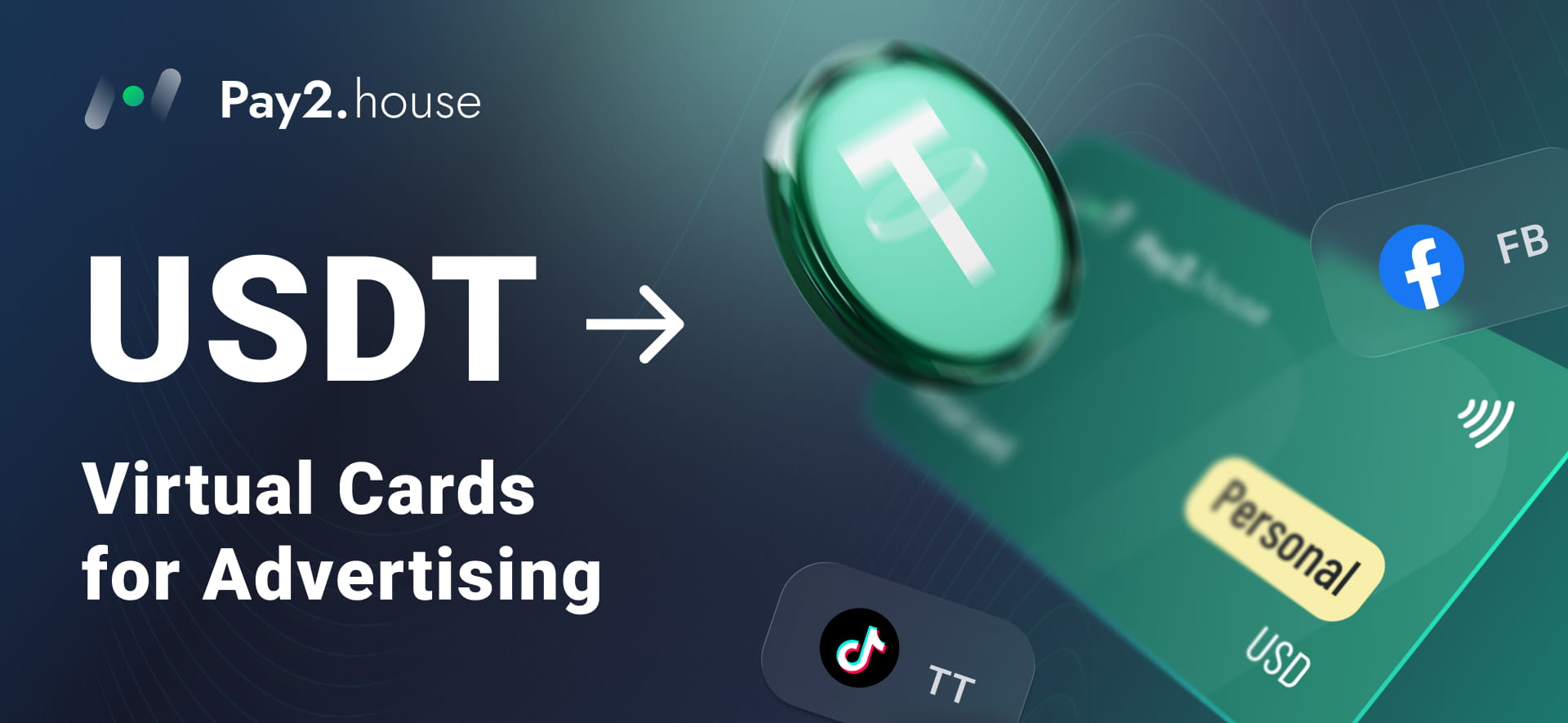
Meta/TikTok require a card: how Pay2.House turns USDT into virtual cards for advertising

Table of Contents:
Launching ads today depends not only on creatives and offers, but also on payment infrastructure. When Meta or TikTok decline a card, the account requests a new billing, and the team loses time replacing payment methods, and the launch starts slowing down already at a basic level.
Pay2.House solves this task through a clear scheme: depositing in USDT, exchange inside the service, and issuing virtual cards for specific advertising or service scenarios.
For account shops, buyers, and teams this is convenient because payments, card issuance, and expense distribution are collected inside one account.
Why the card became part of advertising infrastructure
Today a working card is not an additional tool, but one of the launch elements. If the payment does not go through, the campaign does not start, and if the card quickly goes into decline, the team has to spend time replacing it instead of scaling.
That is why for arbitrage and agency work it is important not just to have virtual cards, but the ability to quickly issue a new card, top it up, and link it to the required platform.
This is exactly the scenario Pay2.House builds its workflow on: account top-up, currency exchange, card issuance, and further work with ad spend.
How Pay2.House works
The service allows you to top up an account, including via USDT TRC20, then exchange funds into the required currency and issue a card for a specific task.
After topping up, card details become available, including CVV and expiry date, and it can be used to pay for ads and online services.
For teams this is convenient for practical reasons: you can keep working capital in USDT, avoid switching between platforms, and issue separate cards for different accounts.
This approach is especially useful when you need to separate budgets between projects and avoid mixing expenses in one card.
GEO and BIN
Pay2.House allows you to choose a card not only by currency but also by GEO and BIN. For advertising and service scenarios this is important because different platforms may react differently to payment data, account history, billing, IP, and payment behavior.
At the moment Pay2.House uses the following working directions:
Estonia | Visa | USD / EUR
A universal option for advertising platforms, online services, and subscriptions.
Suitable when you need a working card for everyday digital payments without being tied to a single scenario.
Hong Kong | Mastercard | USD / EUR
A good choice for advertising and service payments.
Suitable for those who work with several types of online expenses at once and want to keep them in one GEO.
Singapore | Mastercard | USD
Suitable for online payments and working payment scenarios.
A convenient option if the card is needed for broader digital tasks.
USA | Mastercard | USD
Best used only for Facebook Ads, Instagram Ads, and Meta.
This is a specialized option for cases where it is important to separate ad accounts.
USA | Visa | USD
Suitable only for App Store USA and Apple ID USA.
This is a separate scenario for Apple payments where precise US GEO linking is important.
This separation matters because a card in advertising infrastructure must be chosen for the task, not used universally without considering the scenario.
Pay2.House provides payment infrastructure but does not influence decisions of advertising platforms, antifraud systems, or merchants. Payment success depends not only on the card but also on account quality, billing, IP, payment history, and the rules of the specific service.
Universal BIN
Estonia, Hong Kong, and Singapore BINs can be used as basic working options for standard online payments and advertising tasks where no separate specialized BIN is required.
They are suitable for those who need a working payment tool for everyday expenses, services, and some advertising scenarios.
For teams this is convenient when you need to:
- issue separate cards for different accounts;
- separate expenses by projects;
- not mix Meta, TikTok, Google Ads, and service payments in one card;
- understand faster where exactly a payment issue occurred.
Specialized BIN for Meta Ads
For Meta Ads Pay2.House has separate USA Mastercard BINs. They are intended only for Facebook Ads, Instagram Ads, and Meta.
They cannot be used for Google Ads, TikTok Ads, AI services, VPN, marketplaces, games, subscriptions, or any other payments.
USA | Mastercard | USD
Suitable for Facebook Ads, Instagram Ads, and Meta - especially when a separate payment profile is needed for ad accounts. This option is convenient to keep specifically for advertising tasks, so it is not mixed with other expenses.
Better not use for:
Google Ads, TikTok Ads, AI services, VPN, marketplaces, games, subscriptions, and other payments.
This format helps avoid mixing advertising tasks with regular service payments and keeps the card strictly for the scenario it is intended for.
BIN for App Store USA
For App Store USA Pay2.House has a separate BIN: USA Visa USD 448213.
It is suitable for paying for apps, games, and subscriptions via Apple ID USA and is not mixed with advertising scenarios.
To use it, you must follow requirements:
- Apple ID must be in the US region;
- a valid US address is required;
- a valid US ZIP code is required;
- a valid US phone number is required;
- the address must match the ZIP code.
This is important because the App Store checks payment data, and incorrect billing may lead to payment rejection.
How this helps account shops and buyers
For account shops and teams managing multiple accounts at the same time, the main task is to quickly issue a separate payment tool for each launch.
Through Pay2.House this is solved more conveniently because you can top up via USDT, exchange it, issue a card for a specific GEO and BIN, and use it for the required platform.
In practice this provides a clear scheme:
- separate card for separate account;
- separate BIN for separate scenario;
- more control over expenses;
- less risk of mixing budgets and tasks in one tool.
For example, if one card is used across several accounts, after a decline the team does not always quickly understand where exactly the issue occurred. If a separate card is issued for each account, the situation becomes more transparent: you can see which launch is stable and where you need to check the account, billing, or payment history.
Meta, TikTok and Google Ads
Pay2.House separately promotes cards for advertising platforms including Facebook, Google Ads, and TikTok Ads.
For Google Ads you can use available Pay2.House working cards, but the final result depends not only on the BIN. It is important to consider ad account status, billing correctness, payment history, and platform requirements.
For TikTok Ads careful payment handling is also important. You should not make many repeated attempts in a row, suddenly change amounts, or use one card across a large number of accounts.
For Meta Ads the logic is even more precise: Pay2.House has specialized USA Mastercard BINs for Facebook Ads, Instagram Ads, and Meta. This allows not just using a card for ads, but separating payment infrastructure for a specific advertising scenario.
Problem - solution - how Pay2.House helpsWhy Pay2.House looks stronger in this niche
One card for multiple accounts
If one launch is mixed with another, it is easier to issue separate virtual cards for each account. This way expenses do not get mixed and control becomes noticeably more convenient.
Working capital in USDT
If the team stores funds in USDT, you can top up the account in cryptocurrency and continue working inside one service without unnecessary switching between platforms.
Separate billing for Meta
For Facebook Ads, Instagram Ads, and Meta it is better to use a separate card. This helps build payment setup according to platform requirements.
Different payment scenarios
When ads, services, and App Store are needed at the same time, it is more convenient to separate cards by tasks. This way each project stays in its own payment logic.
Budget control by projects
If buyers manage multiple launches, separating cards by accounts and projects helps better track expenses and keep finances under control.
The main advantage of Pay2.House should be considered not abstractly, but through the structure of scenarios.
The service combines:
- USDT deposits;
- currency exchange inside the account;
- virtual card issuance;
- GEO and BIN selection;
- separate solutions for Meta Ads;
- a separate card for App Store USA;
- the ability to separate cards by projects, accounts, and teams.
For arbitrage and media buying teams this is important because payment infrastructure must be not chaotic but manageable. The more accounts, launches, and budgets there are, the more important it is to have separate cards for different tasks.
How to start
The starting path in Pay2.House looks like this: register, activate 2FA, top up the account, optionally exchange USDT to USD or EUR, then issue a card with the required GEO and BIN and use it for the selected scenario.
For the first card issuance you can use promo code PERSONAL. It gives 15 USD bonus balance for issuing virtual cards.
Important: the bonus is used specifically for card issuance. For further work the card must be topped up because payments are made from the card balance itself, not directly from the main account balance.
What next
If the goal is to conveniently pay for ads via virtual cards, work with USDT, and quickly issue separate cards for different tasks, Pay2.House is suitable for this scenario.
This is especially convenient for those working with Meta, TikTok, and Google Ads who want to keep the payment part under control: separate accounts, budgets, GEO, BIN, and not mix different tasks in one card.
Leave a Comment
Comments
No comments yet. Be the first to comment!
You may also like
Spanish Regulator Fines Social Network X €5 Million for Violating Crypto Advertising Rules
14-11-2025
Rating: 0 | Views: 1782 | Reading time: 2 min
Read →
Telegram Tests Built-in Fact-Checking to Combat Misinformation
30-06-2025
Rating: 0 | Views: 2832 | Reading time: 2 min
Read →
The Evolution of YouTube Premium: Smart Acceleration Amid Rising Costs
15-04-2026
Rating: 0 | Views: 959 | Reading time: 4 min
Read →
Meta’s Gallery Scanning: The Future of Frictionless Sharing on Facebook
20-04-2026
Rating: 0 | Views: 836 | Reading time: 4 min
Read →
How Telegram Reduced the Quality of Media Content
21-11-2025
Rating: 0 | Views: 2173 | Reading time: 3 min
Read →